
Paul Dirac: Quantum Mechanics Made Beautiful

Published by Stephen Milward in Science And Technology · Wednesday 06 May 2026 · 2 minutes
Tags: Paul, Dirac, Quantum, Mechanics, Physics, Theoretical, Physics, Science, History, Quantum, Theory, Particle, Physics, Nobel, Prize, Wave, Particle, Duality, Quantum, Field, Theory
Tags: Paul, Dirac, Quantum, Mechanics, Physics, Theoretical, Physics, Science, History, Quantum, Theory, Particle, Physics, Nobel, Prize, Wave, Particle, Duality, Quantum, Field, Theory
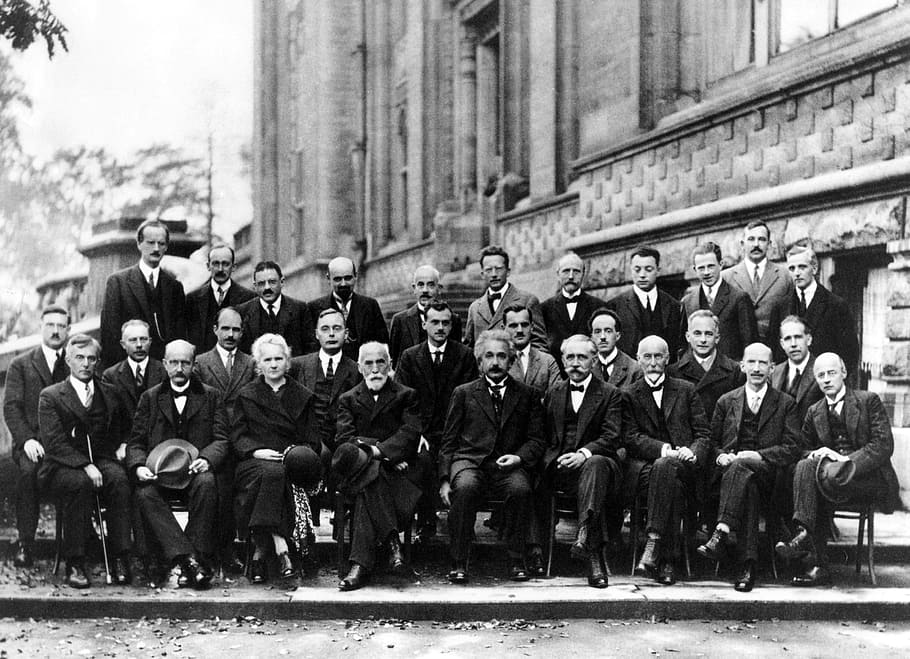
I want to be clear. I'm not a trained, qualified scientist. I'm more of an arts, music, creative person. But every so often, I find my interest in science to be raised. I'm not talking about the big science events, like a space mission. I really talking about those people who transcend the barriers we self-impose on our life categories. In this case, that person is Paul Dirac (i).
Paul Dirac (1902-1984), a British theoretical physicist, may be the most profound scientist that you've never heard of. A Nobel prize winner, he was of the generation of scientists that worked in physics at the most profound time of discovery and research. During this time, Dirac formulated what is one of the most equations yet formed: the 'Dirac Equation' (ii).
Now, to repeat, I'm not a scientist. But the reason I'm writing this post is to highlight what Dirac himself said.
While visiting Moscow State University in 1956, Dirac was asked to summarize his philosophy of physics. He wrote on the blackboard "Physical laws should have mathematical beauty." (iii)
'Mathematical beauty'. The phrase has artistic overtones, a creativity that those whose interest is in the artistic field can relate to. I certainly do. It makes me question the split, or barriers, we self-impose between the sciences and the arts. I believe that that split is artificial and it hampers the growth of humanity's discoveries and growth. Dirac was famously silent, speaking little and always to the point. But he was always working, calculating, thinking beyond the limit.
So, instead of thinking about great people in the sciences and the arts, let's mix them up. Bach, Leonardo, Shakespeare, Einstein, Curie, Dirac, Beethoven...... the list is endless, but make it inclusive.
Listen to the BBC 'In Our Time' radio programme about Paul Dirac here.
(i) Wikipedia: Paul Dirac
(ii) Wikipedia: Dirac Equation
(iii) Helge Kragh: 'Dirac: A Scientific Biography', 1990. Cambridge: Cambridge University Press
